Showing posts with label Tips and Tricks. Show all posts

Friday, October 12, 2012

The Oracle Exadata 11g Essentials (1Z0-536)


Mr. Larry Elison said in one of his recent appearance when launching Exadata X3-2, "SAP Hana is kinda small... about 0.5TB small. It is indeed small. Mine is bigger." and something like that, although I can't remember his exact words.

Too bad, Mr. Bill Gates' Microsoft ain't jump on the bandwagon yet on a totally Microsoft based appliance. Microsoft is working with alliance partners like HP or so in current appliance wave.

So what's the big deal about appliance based solution?

Yeah? What's the big deal?

Appliance is not something new. Seriously.

Early days of computing solution actually were appliance-based! Computer engineers assembled a dedicated computing machine using their own proprietary hardware, software, networking devices, storage and components with performance centric mentality to maximize utilization of available resources. Use some marketing catch words from principals like IBM and Oracle: Balanced Configuration.

Then computing components became commoditized, leveraging economic of scale, drastically lower down prices, improve adoption and innovations. Too bad, the commoditization happened individually for each component. Solutioning process nowadays spends a hell of time and efforts to assemble these "unbalanced" components together and it requires a hell of group of specialized people like systems engineer, storage expert, network specialist and so on together to make sure the end result can somehow meet the real customer needs.

Change is inevitable. Complexity sucks.

Appliance based deployment lowers complexity.

Wait! Oracle actually try to differentiate appliance and appliance-like platform. Exadata is actually a appliance-like platform. What it really means is that Exadata provides almost full flexibility in operating the Oracle database software as if it is in a non-Exadata environment. A true appliance is more limited in terms of configuration. Emm, the characteristics of these two kinds are usually overlapping and we shouldn't waste too much time to try to identify the idiosyncrasy of both since they shall eventually converge into single definition.

So, there are Netezza, Exadata, SAP HANA, Greenplum, HP Vertica, SmartAnalytics and the list goes longer with many smaller players in the market. Gartner Magic Quadrant paper should be able to point out few names in this area.

Anyway, enough of the gibberish speech about appliance.

I think appliance is great as it will cut down my time in assembling a BOM for proposals, although sometimes the price tag is hard to fit into the budget unless Oracle or any appliance vendor is kindly to give out GREAT bid price for us.

I took and passed 1Z0-536 The Oracle Exadata 11g Essentials. Scored 84% . To me, 84% is a score that has plenty of rooms for improvements. I would attribute this below-than-my-average score to the lack of literature about Exadata in the circulation. This is an area for enhancement. Oracle, please take note.

My preparation materials basically include OPN learning materials about Exadata under the specialization track, "Achieving Extreme Performance with Oracle Exadata (Oracle Press)" and many whitepapers/articles.

Some major subject areas tested in the examination are IORM, Database Machine specs and best practices. I got ambushed by some questions about ASM attribute and state of the disks. OUCH! No idea at all what the hell they are and I can only count on my common sense. Non-Exadata Oracle specific knowledge would be a great use here.


Top Blogs

Wednesday, August 22, 2012

MCTS 70-178 Microsoft Project 2010, Managing Projects

Top Blogs


Suddenly I became nostalgic.

You know, Microsoft Project is one of some early batch of software that I used during tertiary education time besides the obvious DOS, Windows operating system, VB (Not .NET you young people!) and et cetera.

I remembered times when being instructed to present my project schedules which ended up with printing of few ten pages of "partial" gantt charts and stitched them together using double sided tapes or glues. Guess not easy to be a project manager during those times. :D

Anyway, transition from the yawning old version of Microsoft Project to the state of the art version of 2010 (2013 on its way) is phenomenal. Number of users grow into millions and with some quarter of them with a chartered PMP qualification. Still, more projects failed in this decade than the total of few previous decades added up. Microsoft Project is just a tool, and it really can't help if you don't understand the essential of managing a project.

Anyway, back to the story of 70-178.

You see, to me, this examination is nothing but just a milestome to tell people that I'm more proficient in using this tool than others. Technically, it's not a tough one either. I have passed various other exams, which I personally think at a different playing field than this exam.

So, don't worry too much if you are taking this exam anytime soon.

What you really need to prepare are:

  • Download the trial version/buy the licensed copy of Microsoft Project 2010
  • Use the software alot, and explore various of its features
  • Understand the basics of project management (If you are a PMP, congrats that you are on a faster track to pass this)
  • Read one or more books on Microsoft Project 2010. I scanned through most of them and I think "Microsoft Project" title from Sybex is short and concise (about 400 pages) whereby "Microsoft Project In Depth" from QuantumPM is indeed, in depth (about 1000 pages).
Well, my passing rate of 962/1000 should indicate to you that the preparation materials above are sufficient. Right?

Can't get the damned "Gangnam style" out from my head. Geez.


Wednesday, September 24, 2008

IBM Websphere Application Server (WAS) V6.1 Network Deployment Certification 253


Preparation for this examination (253) was kinda harsh. I only managed to cram 2.5 of the related IBM Red Books and struggled to get the other questions right using my project experiences.

Study Materials:

WebSphere Application Server 6.1 Planning and Design (SG24-7305-00)
WebSphere Application Server 6.1 System Management and Configuration (SG24-7304-00)
WebSphere Application Server 6.1 Security Handbook (SG24-7304) - Part 1

I really want to read up another one about Performance, Scalability and HA but my schedule was extremely tight, well, maybe will do the reading if going for the advanced certification.

Score: 89%


Top Blogs

Friday, August 22, 2008

Passed IBM DB2 Certification Exam 701

Officially I didn't hold a full time job as DBA in any of my previous employments, however this doesn't stop me from getting one or two DBA certifications, because my hunger for knowledge and piss off with some moments where intricacy of DB technical details hinder my architecting and design process.

Besides all the formal knowledge and information I acquainted, one of the most important experience is to further understand the scope, responsibility and difficulties that real DBA faced in their daily operational routines and when application development needs conflicted with the interest of maintaining corporate data policy and security auditing.

In the enterprise application paradigm, the only way a solution architect can architect a better solution is to completely understood and blend every piece of the jigsaw puzzle together into a coherent whole, in the right way.

That's my motivation. Now let me share my preparation process.

1.) Read up the IBM DB2 701 Preparation Materials from IBM

Nothing much to say here.

2.) Read up DB2® Universal Database™ v8 for Linux®, UNIX®, and Windows® Database Administration Certification Guide, by George Baklarz, Bill Wong

You can opt to skip the last part regarding Application Development, even though no harm for you to take a look into it. That part is more relevant when you were taking exam 703.

3.) Do at least one project dealing with DB2 DBMS

4.) Do your own exploration and experiments with some of the concepts in the materials like HADR, Roll Forward and etc.

5.) Get enough coffee and sleeps. Trade off between these 2 important constraints :-)


Lastly, I'd like you to know that DB2 V9 series of examination is already available and you should jump on the bandwagon of V9 if your company or projects are using it or potentially will. I sticked to V8 because that's the one bundled together with IBM DBW DWE V9.1 and I dealt with that version of DB2 the most.

P/S: I got a 100% score in this exam. Cheers. I finally revenged on my 98% score in exam 700. :EVIL:

IBM DB2 Exam 000-700

I did it in the reverse way. I took the exam 000-705, yet I still haven't take 000-700. It's time now to bridge the gap and to obtain the official title of BI Designer.

Following are the steps I took for the preparation:


1. Read DB2 Family Fundamental Guide from IBM

6 chapters guide. Clear and concise to help you pass above 75%.

2. Read eLearning Crammer Course Material from colleague

Consists some sample questions and added notes for task 1. If you read this, 80% and above shouldn't difficult.

6 chapters guide. Clear and concise to help you pass above 75%.

3. Read a 400 pages book

DB2® Universal Database™ V8.1 Certification Exam 700 Study Guide
By Roger E. Sanders

Must read if you plan to get 85% and above.

4. Use DB2 whenever possible

SQL section constitutes 31% of exam. Practice makes perfect. I wouldn't need to do this step since I'm already quite good in it. :p

Must do if 90% and above is your target

Note: No. No advanced SQL covered in the exam. No recursive SQL you bet!


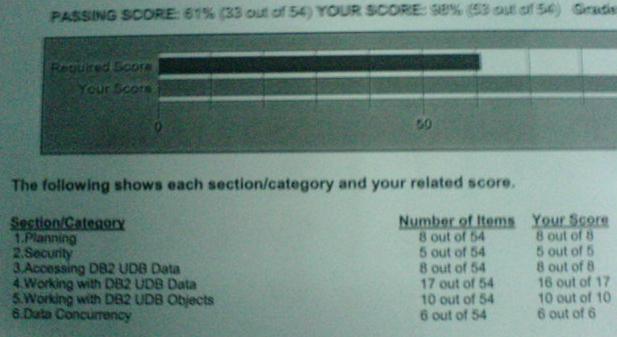
My result sheet


Some of the questions are pretty tricky. I shall not put the real questions here, but just to give you some clues, here is a similar one:

(Not REAL questions)

1.) If you gotta build DB2 application on XXX OS and it need to access YYYY OS DB2 Server when deployed, which of the following DB2 product is the minimal you need?

a. DB2 UDB Personal Edition
b. DB2 UDB Personal Edition with DB2 Connect Enterprise Edition
c. DB2 Personal Developer Edition
d. DB2 Universal Developer Edition

Answer is C. Because you need to build DB2 application, you need the SDK toolkit and at least a DB2 UDB PE for testing, therefore C is the minimal. D can be the answer is the question is not on MINIMAL because DB2 UDE includes every DB2 PDE components. A and B is definitely not the answer since it doesn't include SDK in the package.

and another typical kind of question.

2.) What should you catalog for a client to access a DB2 host database?

Answer: You need to catalog the remote server in the NODE directory, the remote database in the System DB directory AND remote database in the DCS directory since you need to use DB2 Connect to access host database. You need to understand the parameter use in these CATALOG statements.


Good luck for you folks that taking this exam.

IBM DB2 Exam 000-705

To earn the title as IBM Certified Business Intelligence Designer, I got to get myself pass in two exams. 000-700 and 000-705. I already passed the 000-705 BI exam during IBM Malaysia sponsored workshop (It's free for IBM business partner).

Here is the summary of the 000-705 exam preparation and experience.


1. 3 days of IBM DWE V9 bootcamp

Hmmm, not that relevant to the 705 exam, more like IBM try to equip its' business partners presales skills on the new DB2 DWE. It covers topics like the new Design Studio, Intelligent Miner, Cube making and etc.

2. 1 day of 705 exam workshop

It is like a last minute top-up of the knowledge pertaining to the 705 exam objectives. The instructor covers the test objectives one by one, and goes through some sample questions.

3. Self study

Got myself the copy of study guide from IBM web site for BI Designer exam version 7, most of the concepts and theories are still applicable.

Found a few excerpts from the book
"Business Intelligence for the Enterprise",
ISBN: 0-13-141303-1

This book is only 240 pages and it tells you general "stories" of Business Intelligence. Personally, I found it not that useful for the exam, but still something interesting to read about.


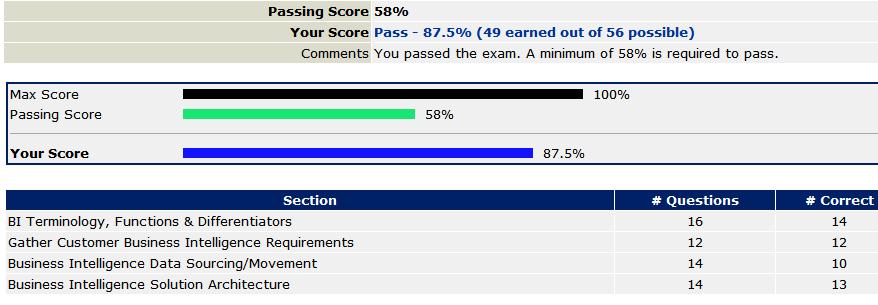
Scored a 87.5% or answered 49 questions correct out of total 56 questions.
Hit major bumper in the section "Business Intelligence Data Sourcing/Movement", which mostly the questions on replication and types of data warehouse processing (full, incremental, snapshot, etc).

705 is not a technical paper. If you have decent experience in data warehousing and business intelligence, then questions in the terminology, requirements and architecture are piece of cake.

Again, it is easy to pass, but hard to score and excel.